Context and Motivation:
The sweeping dismissal of the cabinet is seen as a strategic move by the President to address various challenges and dynamics within the government. It reflects a bold attempt to overhaul the administration, potentially in response to internal discontent, inefficiencies, or to reposition the government ahead of upcoming political or economic challenges.
Political Ramifications:
Internally, the decision has significant political implications. It could be interpreted as a means to consolidate power, address perceived corruption or ineffectiveness, or to rejuvenate the government’s agenda. Such a move reshapes the political landscape, potentially affecting alliances within the ruling party and broader political dynamics across Kenya’s regions.
Impact on Governance and Policy:
The dismissal of the cabinet raises immediate questions about the continuity of government operations and policy implementation. It creates a transitional period where key ministerial roles need to be reassigned promptly to ensure the smooth functioning of essential services and the execution of government programs.
Public and International Response:
The announcement has sparked a range of reactions among the Kenyan public, including both support for the President’s decisive action and concerns over potential disruptions and uncertainties. Internationally, the move is likely to attract attention from diplomatic circles and international partners, influencing perceptions of Kenya’s political stability and governance effectiveness.
Next Steps and Future Outlook:
The focus now shifts to the President’s next steps in appointing a new cabinet. The selection of ministers will be closely monitored for indicators of continuity or change in policy direction, as well as the government’s ability to address pressing national issues such as economic recovery, healthcare, and security.
In conclusion, the decision by the President of Kenya to dismiss the entire cabinet represents a significant and bold maneuver with wide-ranging implications. It underscores the complexities of governance, leadership dynamics, and the evolving political environment within Kenya. The aftermath of this decision will shape future political developments and governance priorities, influencing both domestic stability and Kenya’s international standing.
]]>Israeli tanks advanced on Rafah on Tuesday, seizing the crossing that has been the primary route for humanitarian supplies into the besieged Palestinian region, following weeks of threats to initiate a ground invasion into the city despite opposition from other countries.
The White House denounced the suspension of aid, and a senior US official subsequently disclosed that Washington had put a stop to a bomb shipment last week because Israel had not responded to US concerns about its plans for Rafah.
The incursion into the southern city, teeming with internally displaced inhabitants, coincided with a meeting in Cairo between mediators and negotiators to attempt to broker a ceasefire and hostage release agreement in the seven-month conflict between Israel and the Islamist organisation Hamas.
Requesting to remain anonymous, a top Hamas leader issued a warning, saying that this would be Israel’s “last chance” to release the numerous hostages that the terrorists still had.
The state-affiliated A group from Hamas was meeting with mediators from Qatar, the United States, and Egypt, according to a report published by Al-Qahera News on Tuesday.
Israel was among “all parties” that subsequently agreed to pick up the negotiations. Benjamin Netanyahu, the prime minister of Israel, had earlier stated that a delegation from his nation was already in Cairo.
Israel’s close ally and chief military backer, the United States, said it was hopeful the two sides could “close the remaining gaps.”.
“Everybody’s coming to the table,” US National Security Council spokesman John Kirby told reporters. “That’s not insignificant.”
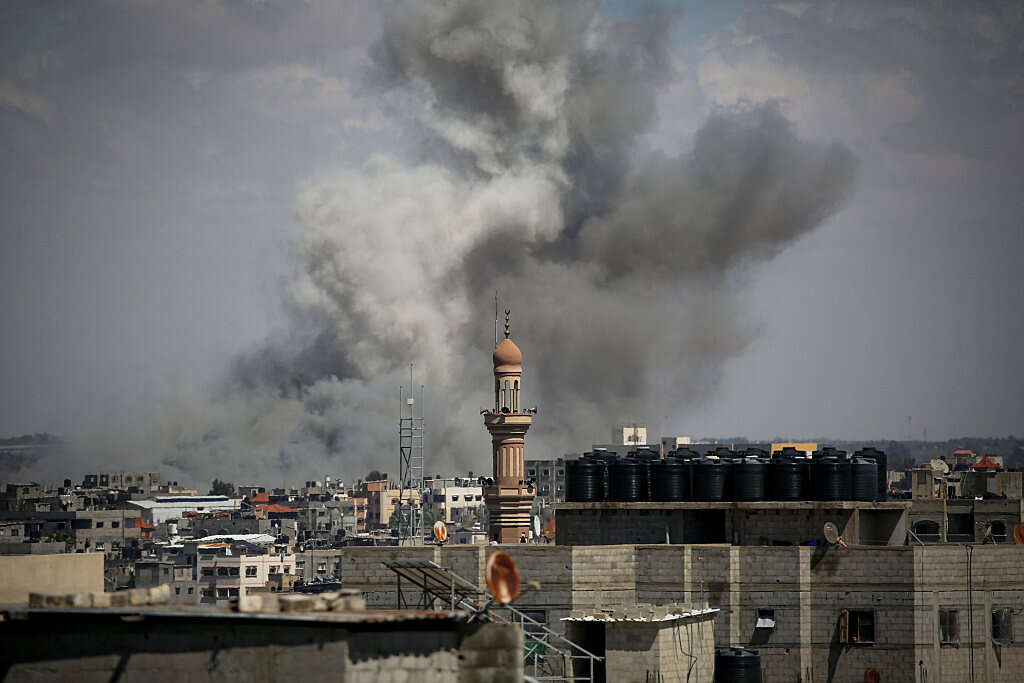
Ongoing strikes
Witnesses and a local hospital reported Israeli attacks throughout the Gaza Strip overnight into Wednesday morning, including in Rafah, despite the Cairo discussions.
Early on Wednesday, an attack on an apartment in the devastated Gaza City neighbourhood claimed the lives of seven members of the same family and injured numerous others, according to the Al-Ahli hospital.
Hours after Hamas declared late on Monday that it had approved a cease-fire proposal, which Israel claimed was “far” from what it had previously agreed upon, Israel launched its Rafah operation.
Nevertheless, the news sent jubilant Gazanians into the streets, though resident Abu Aoun al-Najjar of Rafah claimed the “indescribable joy” was fleeting.
More Israeli bombardments “stole our joy,” he told AFP, adding that “it turned out to be a bloody night.”

Aid blocked, bombs ‘paused’
In a film released by the Israeli army, tanks were shown on Tuesday assuming “operational control” over the Palestinian side of the Rafah crossing.
Being able to deny Hamas “a passage that was essential for establishing its reign of terror” was what Netanyahu called the operation “a very important step.”.
However, Israel has also refused his organisation’s access to Rafah and Kerem Shalom, another significant assistance crossing on the Israeli border, according to UN humanitarian office spokesperson Jens Laerke.
Antonio Guterres, the secretary-general of the UN, called the restrictions “especially damaging to an already dire humanitarian situation” and asked Israel to reopen both crossings “immediately.”.
A similar opinion was expressed by White House Press Secretary Karine Jean-Pierre, who described the closures as “unacceptable.”.
She stated that a reopening of the Kerem Shalom border was anticipated for Wednesday.
Soon after, a high-ranking Biden administration official disclosed, speaking under anonymity, that the US had “paused one shipment of weapons last week” as a result of Israel’s failure to answer Washington’s concerns regarding the Rafah incursion, to which Washington has strongly objected.
According to the official, the cargo included almost 3,500 heavy-duty bombs.
For the first time, Biden had followed through on a warning he issued to Netanyahu back in April: that US policy in Gaza would be contingent on Israel’s treatment of civilians.
According to the US official, Washington was “particularly focused” on the potential effects of using the largest bombs—2,000 pounds or 907 kilogrammes—in densely populated areas.
The source did, however, add, “We haven’t decided how to go with this in the end.
According to the US official, Washington was “particularly focused” on the potential effects of using the largest bombs—2,000 pounds or 907 kilogrammes—in densely populated areas.
The representative did, however, clarify that “we have not made a final determination on how to proceed with this shipment.”
Meanwhile, the Pentagon announced that the US military has finished building an aid dock off the shore of Gaza; however, due to the current weather, it is unsafe to move the two-part facility into its proper location.
In order to “gain a deeper understanding of the perspectives of Egyptian military leaders on regional security and the status of humanitarian aid,” General Michael Erik Kurilla, the head of the US Central Command, was reported to have visited Egypt on Monday and Tuesday.
In a film released by the Israeli army, tanks were shown on Tuesday assuming “operational control” over the Palestinian side of the Rafah crossing.
Being able to deny Hamas “a passage that was essential for establishing its reign of terror” was what Netanyahu called the operation “a very important step.”.
However, Israel has also refused his organisation’s access to Rafah and Kerem Shalom, another significant assistance crossing on the Israeli border, according to UN humanitarian office spokesperson Jens Laerke.
Antonio Guterres, the secretary-general of the UN, called the restrictions “especially damaging to an already dire humanitarian situation” and asked Israel to reopen both crossings “immediately.”.
A similar opinion was expressed by White House Press Secretary Karine Jean-Pierre, who described the closures as “unacceptable.”.
She stated that a reopening of the Kerem Shalom border was anticipated for Wednesday.
Soon after, a high-ranking Biden administration official disclosed, speaking under anonymity, that the US had “paused one shipment of weapons last week” as a result of Israel’s failure to answer Washington’s concerns regarding the Rafah incursion, to which Washington has strongly objected.
According to the official, the cargo included almost 3,500 heavy-duty bombs.
For the first time, Biden had followed through on a warning he issued to Netanyahu back in April: that US policy in Gaza would be contingent on Israel’s treatment of civilians.
According to the US official, Washington was “particularly focused” on the potential effects of using the largest bombs—2,000 pounds or 907 kilogrammes—in densely populated areas.
The source did, however, add, “We haven’t decided how to go with this in the end.
According to the US official, Washington was “particularly focused” on the potential effects of using the largest bombs—2,000 pounds or 907 kilogrammes—in densely populated areas.
The representative did, however, clarify that “we have not made a final determination on how to proceed with this shipment.”
Meanwhile, the Pentagon announced that the US military has finished building an aid dock off the shore of Gaza; however, due to the current weather, it is unsafe to move the two-part facility into its proper location.
In order to “gain a deeper understanding of the perspectives of Egyptian military leaders on regional security and the status of humanitarian aid,” General Michael Erik Kurilla, the head of the US Central Command, was reported to have visited Egypt on Monday and Tuesday.
‘Until the first hostage returns.
An AFP count of Israeli official numbers indicates that around 1,170 people, largely civilians, died as a result of Hamas’s unprecedented strike on Israel on October 7, which set off the Gaza conflict.
Israel’s retaliatory offensive, which it declared would destroy Hamas, has killed at least 34,789 people in Gaza to date, the majority of them women and children, according to the health ministry of the Hamas-run enclave on Tuesday.
On October 7, militants also kidnapped some 250 people; of them, Israel calculates that 128 are still in Gaza, including 36 who are thought to have died.
If discussions fail to bring the hostages home, Israel may “deepen” its operation in Gaza, according to Defence Minister Yoav Gallant.
“This operation will continue until we eliminate Hamas in the Rafah area and the entire Gaza Strip, or until the first hostage returns,” he added in a press release.
In the truce negotiations, Egypt and Qatar have assumed a major role. On Monday, Hamas announced that it had informed representatives of both nations of its “approval of their proposal regarding a ceasefire.”.
The plan called for a “permanent ceasefire” and included a full Israeli departure from Gaza, the return of Palestinians who had been displaced by the conflict, and a hostage-prisoner exchange, according to Hamas member Khalil al-Hayya, who spoke to the Qatar-based Al Jazeera news station.
The proposal, according to Netanyahu’s administration, is “far from Israel’s essential demands,” but the government will nonetheless send negotiators to Cairo.
Concern about the ramifications of an Israeli ground invasion on Rafah, where the UN estimates 1.4 million Palestinians are seeking sanctuary, has grown on a global scale.
However, Netanyahu has always stated that Israel must eliminate any residual Hamas fighters and that Israel will send in ground soldiers regardless of any peace.
The coastal “humanitarian area” of Al-Muwasi, where Israel’s military instructed refugees to go before the start of the Rafah operation, has been cautioned by aid organisations that it is not equipped to handle the surge.
]]>Exclusive News
The archbishop of the Anglican Church of Rwanda, Laurent Mbanda, has accused the top bishop of the Church of England, Justin Welby, of perpetuating colonialism with his criticism of Uganda’s anti-LGBTQ law.
In a statement last Friday, the archbishop of Canterbury, Justin Welby, expressed his concerns about the Ugandan Anglican Church’s support for the country’s widely criticized Anti-Homosexuality Act, which imposes life in prison for gay sex and the death penalty for “aggravated homosexuality.”
Welby asked the sister church to reject the legislation as “there is no justification for any province of the Anglican Communion to support such laws” after he had earlier written to Archbishop Stephen Kaziimba, the primate of Uganda, conveying “grief and dismay.”
But, in response, Mbanda, who is chairperson of the Global Anglican Future Conference (GAFCON), said it was “unfortunate” that Welby did not express the same “grief or sorrow over the crisis that has torn apart the Anglican Communion under his watch.”
He recalled that the archbishop of Canterbury has previously issued statements criticizing the Anglican provinces of Kenya and Nigeria as well.
“It seems the history of colonization and patronizing behavior of some provinces in the Northern Hemisphere towards the South, and Africa in particular, is not yet at an end,” Mbanda said on Wednesday.
Welby stated last week that he was aware of the history of British rule in Uganda and that his call for the church to reject the anti-gay law was not about “imposing Western values.” He described it as a reminder of the commitment to “treat every person with the care and respect they deserve as God’s children.”
In response to Welby’s criticism, Kaziimba said on Friday that the Ugandan church had made “clear” its endorsement of the anti-gay law and will not repeat its position.
He said the Church of England’s primate “has every right to form his opinions about matters around the world that he knows little about firsthand.”
“We do pray for him [Welby] and other leaders in the Church of England to repent,” Kaziimba added.
Leaders of 85 percent of the Anglican communion agreed at the fourth GAFCON in April, held in the Rwandan capital, Kigali, to cease to recognize the archbishop of Canterbury as a symbol of their common communion, according to Kaziimba.
Read more
]]>Exclusive News
Some 65 survivors of the Kenyan Christian cult who were rescued from the Shakahola Forest in Kilifi County are being charged with attempted suicide, local media reports. They were arraigned in Shanzu law court on Monday for trying to kill themselves by refusing to eat their meals while at the Sajahanadi Rescue Center in Mtwapa, according to RT News.
According to a charge sheet prepared by the country’s public prosecutor’s office and cited by local media, the survivors, who are now suspects, went on hunger strike between June 6 and 10.
The prosecution asked the court on Monday to remand them in prison because the Rescue Center could no longer accommodate them.
“They have now turned into suspects of attempted suicide. It is in prison that they will undergo mental and medical assessment and be forced to eat,” the prosecution is quoted by Nairobi-based newspaper The Star as saying. The court is expected to rule on the application on Thursday.
In Kenya, attempted suicide is a criminal offense punishable by two years in prison, a fine, or both, according to Section 226 of the Penal Code. The law was enacted by the British and was passed down to the East African country. The same statute was repealed in England more than 60 years ago, and Kenyan activists have been campaigning for its annulment, arguing that it was imposed by an “outside force.”
The 65 defendants are said to be followers of Pastor Paul Mackenzie, the alleged cult leader charged with terrorism for instructing his devotees to fast to death in order to “meet Jesus.”
Mackenzie was arrested in April and has been in custody since then. On Monday, investigators exhumed ten more bodies, bringing the total number of victims buried in shallow graves across Mackenzie’s 800-acre property in Kenya’s Shakahola forest to 284. According to autopsy reports, the majority of the victims, including children, died of starvation, while others were strangled or beaten to death.
The exhumation process is planned to resume on Tuesday.
Read more
]]>Exclusive News
The Archbishop of Canterbury, Justin Welby, has voiced concern over the Ugandan Anglican Church’s endorsement of a recently passed Anti-Homosexuality Act, and urged the sister church to oppose it.
“There is no justification for any province of the Anglican Communion to support such laws: not in our resolutions, not in our teachings, and not in the Gospel we share,” Welby said in a statement on Friday.
The leader of the Church of England said he had written to Archbishop Stephen Kaziimba, the Primate of Uganda, to express “grief and dismay” and to stress the inconsistency between the Church’s stance on the anti-gay law and its alignment with “Resolution i.10.”
Resolution i.10 of the 1998 Lambeth Conference, a meeting of Anglican Bishops held every 10 years, established teaching on marriage as being between a man and a woman, and the church’s stance on homosexuality.
The resolution “expressed a commitment to minister pastorally and sensitively to all – regardless of sexual orientation – and to condemn homophobia,” the leader of the worldwide Anglican Communion explained.
Kaziimba issued a statement in May after President Yoweri Museveni approved the widely criticized law, saying the church was “grateful” for its passage. He insisted that homosexuality was being forced on Ugandans by “foreign actors” seeking to undermine the culture of the former British colony.
“We thank the President for not surrendering to their threats and for protecting Uganda from their paths of self-destruction,” the bishop noted.
Archbishop Welby, while acknowledging the injustice of colonial rule in the East African country, argued that protesting against the anti-gay law, which imposes life in prison for gay sex and the death penalty for “aggravated homosexuality,” is not about “imposing Western values” on Ugandans.
“It is about reminding them of the commitments we have made as Anglicans to treat every person with the care and respect they deserve as children of God,” he said.
He urged the Church of Uganda and its leader to rethink their support for the legislation and to reject the criminalization of LGBTQ people.
Read more
]]>Exclusive News
Kenyan police discovered 15 additional bodies on Wednesday, bringing the death toll from the ‘Shakahola Forest Massacre’ near the coastal town of Malindi to 226, according to RT News.
Last week, investigators reported organ harvesting in some of the first 112 bodies to be found. Most of the victims are said to have died of starvation after allegedly following the instructions of Paul Nthenge Mackenzie, who is facing terrorism charges.
Mackenzie, the founder of the Good News International Church, is being held by police for allegedly inciting his followers to engage in ritual fasting in order to “meet Jesus.”
Faith Ambole, a local resident who spoke with RT, said she has been trying to locate five relatives who were members of the religious sect but has been unsuccessful. “I’m calling on the government to intervene and help us, we have no means, we are poor,” Ambole said.
Over the weekend, Kenyan President William Ruto accepted responsibility for not doing more to prevent radicalization, and apologized for the government’s “laxity” in the case.
Read more
]]>Exclusive News
The administration of US President Joe Biden sold weapons to at least 57% of the world’s authoritarian regimes in 2022, according to analysis published on Thursday by The Intercept. In a lengthy review of US arms-dealing practices and recently released government data, the American publication noted that Washington has accounted for around 40% of global arms sales each year since the end of the Cold War, according to RT News.
It added that, according to a classification system devised at the University of Gothenburg in Sweden, the United States distributed weapons in 2022 to at least 48 of 84 (57%) countries described by the ‘Varieties of Democracy’ project as being under autocratic or authoritarian rule.
The Swedish study categorized global governments on a scale ranging from ‘closed autocracy’ to ‘liberal democracy’, principally using methodology to discern how free and fair a country’s elections might be.
US weapons exports are typically divided into two categories: foreign military sales (FMS) and direct commercial sales (DCS). FMS requires the US government to act as a direct intermediary, with Washington buying the assets from a weapons manufacturer before it provides them to a foreign government.
DCS deals, meanwhile, largely removes from the government’s intermediary role and permits manufacturers to sell directly abroad. Both types of sale require full approval from Washington.
According to government data, the United States sold arms in FMS deals to 142 countries and territories last year, producing $85 billion in bilateral sales. In Biden’s first full year as president, US weapons sales to foreign countries amounted to $206 billion – surpassing a Trump-era record of $192 billion.
The US has been a key weapons supplier to Ukraine throughout its conflict with Russia. The Intercept noted, however, that this does not fully explain the boom in Washington’s arms export industry last year, as much of the weaponry was provided to Kiev in the form of grants. Russia’s offensive also began five months into the 2022 fiscal year.
The findings of the analysis stand in contrast to Biden’s often-repeated stance of opposition to authoritarian governments. In a speech in Warsaw last year, the US president described conflict between democracy and autocracy as a battle “between liberty and repression” and “between a rules-based international order and one governed by brute force.”