Exclusive News
The Chinese-owned social media platform TikTok announced on Wednesday that it will crack down on “misinformation” about climate change and elevate “authoritative information” from independent fact-checkers. The changes will take effect on April 21, to mark Earth Day.
The new policy was announced in a blog post on “driving sustainability awareness” ahead of the environmentalist holiday. Believing it has “an important role to play in empowering informed climate discussions” on its platform, the company said it was rolling out “several initiatives that will help reduce harmful climate change misinformation while elevating authoritative information year-round.”
Starting Friday, content on the platform will be inspected for accuracy by TikTok’s “safety partners,” and labeled misinformation if it “undermines well-established scientific consensus,” such as “denying the existence of climate change or the factors that contribute to it,” the company said.
As UK’s Sky News pointed out, TikTok has “toughened its stance on harmful content” in recent months after facing pressure from Western governments on privacy and safety, as it is owned by the Chinese company ByteDance.
Earlier this month, British regulators fined TikTok £12.7 million ($15.9 million) for not removing users under the age of 13 and using their data without parental consent. Last month, the head of the US spy agency NSA described the platform as China’s “Trojan horse” that can present “divisive material” to the American public.
The US federal government and half the states have banned TikTok on official devices. In the name of banning TikTok altogether, some US lawmakers have proposed the RESTRICT Act, which critics say would enable total surveillance and censorship of all social media.
The Chinese government has insisted that it “takes data privacy and security very seriously” and has never asked – nor will it ask – “any company or individual to collect or provide data, information or intelligence located abroad against local laws.”
TikTok’s response to government pressure mirrors that of Silicon Valley-based platforms such as Facebook, Twitter and YouTube, all of which embraced varying degrees of censorship and “content moderation” after the 2016 US presidential election.
Independent journalists granted access to Twitter’s internal documents have shown that much of the censorship push was driven by the “Russiagate” conspiracy theory, promoted by government officials, media outlets and newly minted “misinformation experts” working together in what has been dubbed the “censorship-industrial complex.”
Read more
]]>Exclusive News
According to RT News, among the classified documents allegedly leaked by US Air National Guardsman Jack Teixeira, as part of a huge trove, is one exposing how the US is spying intently on UN Secretary-General Antonio Guterres, and is deeply unhappy that he is engaging with Moscow.
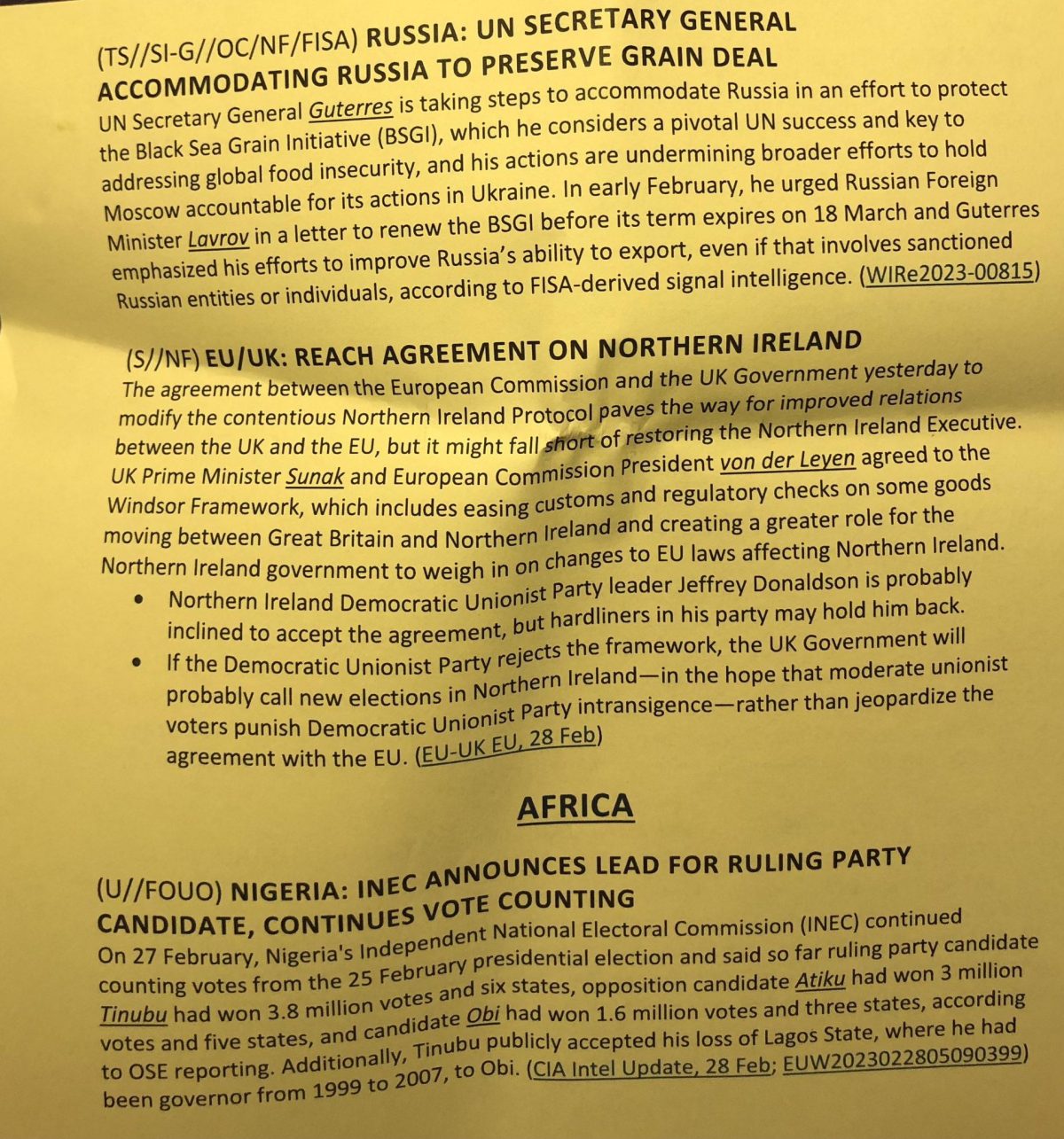
What do we learn from this leak?
Several files that Teixeira shared with other members of a private Discord chat, an action that may land him in a US supermax prison for the rest of his life, show Washington is keeping a very close eye on all Guterres’ sensitive private communications. One accuses him of “accommodating Russia to preserve [the] grain deal.” According to “FISA-derived signal intelligence,” Guterres is “taking steps to accommodate Russia in an effort to protect the Black Sea Grain Initiative (BSGI).”
“[Guterres] considers [BSGI] a pivotal UN success and key to addressing global food insecurity, and his actions are undermining broader efforts to hold Moscow accountable for its actions in Ukraine. In early February, he urged Russian Foreign Minister [Sergey] Lavrov in a letter to renew the BSGI before its term expires on 18 March and Guterres emphasized his efforts to improve Russia’s ability to export, even if that involves sanctioned Russian entities or individuals.”
The document is likely to have been written in late February or early March, before Russia and Ukraine agreed to extend the grain deal. To broker it, the UN said it would facilitate the export of Russian fertilizer and grain, which was blocked by Western sanctions despite exemptions for agricultural goods. Since the resumption, several governments have rejected grain flowing from Ukraine due to its poor quality.
Numerous other leaked documents contain accounts of Guterres’ private conversations with aides on diplomatic matters and meetings, along with accompanying commentary from US intelligence officials. Some suggest his relationship with Ukrainian President Vladimir Zelensky is far from cordial. One document referring to his trips to Iraq and Qatar in early March notes he was “not happy” about the prospect of traveling on to Kiev days after returning from Doha, despite the Ukrainian government’s request.
It’s uncertain why Guterres was resistant to visiting Kiev, but the trip went ahead, and included a private meeting with Zelensky and a joint press conference on March 8. The UN secretary-general regretted going. Another document records a conversation between Guterres and his personal spokesperson, Stephane Dujarric, in which he was “really pissed off” about an unexpected public ceremony in honor of International Women’s Day during the visit.

The document indicates aides later discussed how Zelensky had sprung the event, which included the presentation of medals to uniformed soldiers, on Guterres without warning or his consent, and later posted misleading photographs and videos that implied he was congratulating Ukrainian military personnel alongside the president. It is recorded in the file that the UN secretary-general “emphasized that he made a point of not smiling the entire time” in later conversations with aides.
No alarms and no surprises
“[Guterres] is not surprised by the fact that people are spying on him and listening in on his private conversations,” Dujarric has commented on the leaks. “What is surprising is the malfeasance or incompetence that allows for such private conversations to be distorted and become public,” the spokesman added.
Guterres’ lack of surprise that he is spied on by the US is understandable, given the country’s history of espionage targeting the UN and its senior officials. The organization’s founding charter is the product of such activity.
The US sought to manipulate the form and content of the UN by conducting espionage operations against the charter’s signatories, intercepting coded cable traffic to and from other members. This granted the US intimate advance knowledge of the negotiation positions of all 49 countries. Academic Stephen Schlesinger says the US was able to “write the UN Charter mostly according to its own blueprint” through this operation.
The US has since been repeatedly caught spying on the UN. In 2003, as the Security Council prepared to vote on the Iraq War, the NSA conducted a “dirty tricks” campaign against delegations in New York to win votes in favor of intervention. This included interception of the home and office telephones and emails delegates.
A memo from the NSA’s chief spoke of stepping up intelligence gathering operations “particularly directed at…UN Security Council Members” minus the US and UK, to gain up-to-the-minute intelligence for Bush administration officials on the voting intentions of UN members regarding the issue of Iraq.
Then, in 2010, it was revealed that Washington was running a secret intelligence operation targeting the leadership of the UN, including then-Secretary-General Ban Ki-moon, and permanent Security Council representatives from China, Russia, France and the UK. A classified directive was issued to US diplomats under Hillary Clinton’s name the previous year, demanding forensic technical details about communications systems used by UN officials, including passwords, personal encryption keys, and even detailed biometric information and credit card numbers.
By Felix Livshitz
Read more
]]>Exclusive News
The battle for control of Sudan has entered its fifth day, following the failure of a 24-hour armistice declared on Tuesday by the Sudanese military and a rival paramilitary group.
What is the current situation in Sudan?
There is heavy fighting in the country’s capital, Khartoum, the adjoining city of Omdurman, and in other flashpoints after clashes broke out between the Sudan Armed Forces (SAF) and the Rapid Support Forces (RSF) on Saturday. At least 270 people have been killed and more than 2,600 others injured in the armed conflict, the World Health Organization has estimated, citing Sudan’s Ministry of Health. The Sudan Doctors Union said on Wednesday that more than half of the hospitals in the capital and adjacent cities have been left incapable of serving patients after some were bombed, while others were attacked and looted.
What is the cause of the conflict?
The conflict is being fueled by a power struggle between General Abdel Fattah al-Burhan, who leads the SAF, and his rival, General Mohamed Hamdan Dagalo, also known as Hemeti, leader of the RSF. Tensions have arisen from a dispute over the integration of the RSF, a paramilitary force, into the country’s armed forces, as well as the jurisdiction that should supervise this procedure. The merging process is a crucial requirement outlined in Sudan’s transition agreement, which was initially planned for April 1 but as yet has not been signed.
What is the transition agreement?
In April 2019, a military coup jointly staged by the RSF and SAF led to the ousting of President Omar al-Bashir, who had been in power for 30 years. A power-sharing agreement was reached in August 2019 between the Transitional Military Council and the Alliance for Freedom and Change, forming an 11-member Transitional Sovereignty Council (TSC) to pave the way for a civilian-led transitional government. The country has since been governed by the TSC, with army chief al-Burhan as president and the RSF’s Hemeti serving as deputy chairman. Another coup in October 2021 disrupted the transition agreement, leading to a new deal last December.
Why does the RSF oppose integration into the country’s armed forces?
There were reports of a disagreement between Hemeti and al-Burhan over the appointment of the commander-in-chief of the military during the multi-year integration period, with the RSF advocating for the civilian head of state to take up the position, which the army opposes. Adel Abdel Ghafar, a fellow at the Middle East Council, also told the media that the RSF “has resisted integration into the army” because it fears “it would lose its power.”
How has the conflict affected the international community?
Fighters have reportedly targeted aid workers, hospitals, and diplomats. Josep Borrell, the European Union’s foreign policy chief, said on Monday that the EU ambassador to Sudan “was assaulted in his own residency.” A convoy of US embassy vehicles also allegedly came under attack on the same day. The Indian Embassy also announced on Sunday that one of its nationals “who got hit by a stray bullet” on Saturday had “succumbed to his injuries.” The UN World Food Programme temporarily halted its operations in Sudan after three employees were killed.
What is the way forward?
Pressure is mounting on the warring parties to call a halt to the fighting so that stranded residents can receive desperately needed relief and supplies. Both sides have accused the other of violating the previous ceasefire. The RSF has again announced its “full commitment to a complete ceasefire” in the next 24 hours, “starting from six o’clock in the evening today, Wednesday, corresponding to 4/19/2023, until six o’clock in the evening tomorrow, Thursday, 20/4/2023.” The group has urged its adversary, which has yet to comment on the proposal, to “abide by the armistice according to the announced time.”
READ MORE: Warring sides agree to 24-hour ceasefire in Sudan
According to Al Jazeera, while other countries are concerned that the conflict could escalate, the Sudanese doctors’ committee has warned of a looming “paralysis of the health system in Sudan.”
The statements, views and opinions expressed in this column are solely those of the author and do not necessarily represent those of RT News.
Read more
]]>Exclusive News
South Africa took over as Chair of BRICS on January 1, 2023 in a difficult national and global economic environment. The conflict in Ukraine and the West’s unilateral sanctions, have battered economies that were struggling to recover from the Covid-19 pandemic.
With Russia being the world’s third-largest oil producer, second-largest natural gas producer, and a top producer of steel and wheat, the conflict has led to substantial increases in food and energy prices that have disproportionately impacted those of us in the Global South.
As a government, we have the South African Economic Reconstruction and Recovery Plan with detailed interventions to address our energy crisis with the aim of fixing Eskom (South African Energy Supply Commission), fundamentally transforming the electricity sector to achieve long-term energy security, and enabling and accelerating investment in the energy sector. It is clear that we cannot do this alone. President Cyril Ramaphosa has called on our BRICS partners to assist South Africa in our recovery.
Our first priority responds to the significant transformational changes we are making in our economy, particularly in the energy sector. Therefore, we aim to “Develop a partnership towards an equitable Just Transition.” This priority focuses on finding solutions to transformational energy change which will also improve people’s livelihoods in the sectors that supported the old economy, such as mining.
BRICS countries are uniquely positioned to support South Africa’s energy recovery. Member countries contain almost half the world’s population and account for approximately 40% of the world’s energy consumption, including 48% of coal, 22% of oil, and 13.5% of natural gas.
While renewable energy consumption is only 16% of the BRICS total at the moment, it has been growing year by year driven by members’ commitment to mitigating climate change.
BRICS countries are not only consumers of energy, as all members have substantial fossil fuels and available renewable energy resources. Members hold 40% of the world’s coal reserves, 25% of the world’s natural gas reserves and 8% of the world’s oil reserves. In the renewable energy sector, solar power from South Africa, Brazil and India, wind power from Russia and China, as well as biomass from Brazil, all enjoy substantial resource advantages.
Within BRICS, China is the world’s largest coal producer with 50% of the world’s output in 2020 with India at 10%. Russia produced 12% of the world’s oil and 16% of the world’s natural gas. Brazil is rich in biomass energy and its output was 25% of the world’s total in this sphere in 2020.
With our natural resources, BRICS countries are major players in the global supply of energy and its dynamics. Member countries have developed similar energy policies to manage energy risks while having both expertise and technologies to use their energy resources to enhance energy security and cooperation.
BRICS recognised these complementarities and in 2020, it adopted a Road Map for Energy Cooperation up to 2025 aimed at building a strategic partnership. The Road Map is being implemented in phases.
The research phase is first and started under South Africa’s chair of BRICS in 2018 with the establishment of the BRICS Energy Research Cooperation Platform. The platform brings together experts, companies and research institutes to coordinate common interests of members in research and development of innovative technology and policies, with seven studies being released to date at the BRICS Ministers of Energy meetings. Last year, China presented an additional study on the development of renewable energy and smart grids in the member countries. This year, Russia is leading a study on energy security. The roadmap also established the publication of the annual BRICS Energy Report.
During the second phase, BRICS countries will identify the needs and challenges to energy security and find areas where member cooperation can provide solutions. The third phase aims at advancing mutually beneficial cooperation including the exchange of best practices, use of advanced technology, as well as opportunities for trade and investment in each other’s economies. Of course, we are not waiting for this third phase before we work with our partners on energy solutions.
India is already South Africa’s biggest coal export market and generates almost half of our total coal revenue. China is reopening opportunities for imports from South Africa, following its political fallout with Australia, previously an important coal source. China has substantial oil and gas trade with Russia, oil and gas cooperation with Brazil, a joint natural gas pipeline project with India as well as renewable energy trade with South Africa. South Africa is a pioneer in the area of clean coal, in which India and China have an interest. The Russian state energy company Rosatom has signed an agreement with South Africa to construct small hydropower plants in Mpumalanga as a key component of South Africa’s energy security strategy.
Part of South Africa’s response to the energy crisis involves implementing a just transition to a low carbon economy. Climate change also poses considerable risks to jobs, businesses and the economy. South Africa is among the most water-scarce countries in the world, and recent events in KwaZulu Natal have shown that extreme weather events such as floods are occurring more often and with a devastating impact on our infrastructure.
The response to the electricity crisis provides an opportunity to also mitigate our contribution to, and the risks from, climate change and adapt to a low carbon economy.
South Africa’s Just Transition Plan aims to significantly lower emissions of greenhouse gasses and harnesses investments in new energy technologies, electric vehicles, and energy-efficient appliances. As a consequence, South Africa’s Integrated Resource Plan, which drives our energy policy, envisions that renewable solar and wind energy will generate almost 25% of our electricity by 2030. Coal, which currently accounts for 85% of South Africa’s electricity generation, will drop below 60% in less than a decade.
The impact on communities reliant on coal extraction and production is an important element of the Just Transition as it aims to ensure that communities tied to high-emitting energy industries are not left behind and are provided with new skills and new economic and employment opportunities.
During South Africa’s Chairship of BRICS in 2013, we established the BRICS Business Council to strengthen and promote economic, trade, business and investment ties among the business communities of the member countries. The BRICS Business Council also identifies problems and bottlenecks and recommends solutions.
This year, under South Africa’s Chairship, the Council’s Energy and Green Economy Working Group is focused on concrete outputs on the Just Transition. The Council has developed an energy skills roadmap for South Africa which will be rolled out to the other members. The roadmap identifies the necessary and available skills and identifies training programmes as well as sponsors across the member countries.
There are discussions on the possible establishment of a BRICS African Centre of Excellence on the Just Energy Transition which would support a network of researchers focused on technology, socio-economic, environmental, financial and other aspects of the Just Transition that would inform policy makers in collaboration with the BRICS Energy Research Cooperation Platform.
The question is how to identify funding for investment in renewable energy. There is significant money available globally for renewable energy projects, with the National Treasury estimating $12 trillion in available sources such as the Green Climate Fund. But developing countries struggle to access these funds because of the perceived risk of investing in a developing country. South Africa’s policy uncertainty and regulatory challenges have been cited as obstacles to South African investment opportunities, with other funders also banning financing and investment in coal for energy, even if it is clean coal.
India and China are able to source their own international finance for renewable energy by offering their own-currency Green Bonds known as Green Masala Bonds and Green Panda Bonds. The Green Panda Bond is issued by the BRICS New Development Bank (NDB).
The NDB is a multilateral development bank established by BRICS countries to mobilize resources for infrastructure and sustainable development projects. Sustainability is fundamental to the founding principles of the NDB, and aims to deliver transformative impact to member countries with a target of 40% of all the NDB’s loans funding projects in mitigation of and adaptation to the effects of climate change by 2026.
South Africa and China have so far been the leading beneficiaries of sustainable financing from the NDB with respect to clean and renewable energy. South Africa is the beneficiary of 12 projects financed by the bank valued at $5.4 billion. Five of these projects support the energy sector, with three of those funding renewable energy projects worth 13 billion rand ($710 million).
The opportunities for BRICS to support transformative change in our economy are obvious. As Chair of BRICS this year, our strategic vision is to harness our existing mutually beneficial cooperation to address issues of national interest and national concern for South Africa in a holistic and multi-disciplinary way. The depth and strength of our partnership allows us to bring multiple solutions to the table, including financing, trade, investment, industrialization, training and development, research, innovation, as well as partnership with African countries and leading countries of the Global South.
This article was originally published on the BRICS information portal
The statements, views and opinions expressed in this column are solely those of the author and do not necessarily represent those of RT News.
Read more
]]>Exclusive News
Despite the prevalence of CCTV and security guards, more than 6,500 rapes and sexual assaults – some against children under 13 – have been committed in hospitals in England and Wales since 2019, according to a report by the Women’s Rights Network (WRN) published on Monday, according to RT News.
A least 2,088 rapes and 4,451 sexual assaults in hospitals were recorded by police forces in the UK between January 2019 and October 2022, the organization said, citing Freedom of Information requests to 43 police forces. One in seven of these attacks took place inside hospital wards, the report stated.
Among the crimes reported were the rape of a female child under 13 and the gang rape of a female over 16 in two West Midlands hospitals. Three rapes of a female under 16 were reported in Cambridgeshire, while six girls under the age of 13 were raped in Lancashire, the report alleges.
The records obtained did not list victims’ gender, which was determined through further investigation by the WRN. At least 14 attacks involved a male victim, one of whom was under the age of 13, the report stated.
“These statistics are jaw-dropping,” WRN founder Heather Binning said in a statement. “The volume of sexual assaults and rapes is even more horrific when you consider that this data covers the pandemic, when much of the country was in lockdown and hospitals were supposedly even more vigilant.”
Out of 6,539 cases reported to police, only 265, or 4%, ended in criminal charges against a suspect. The WRN noted that during its investigation, seven police forces provided incomplete information, five refused to disclose how many attacks took place in hospital wards, and three declined to give information on the number of suspects charged. Scottish police provided no information at all, due to alleged “cost constraints.”
The WRN recommended that hospitals review their security plans and install additional CCTV cameras if necessary, and that the UK Home Office force police to record more data on sexual assaults in hospitals. Additionally, the organization called on the National Health Service to repeal its 2019 guidelines under which transgender women – who are biologically male – are allowed in women’s wards.
Read more
]]>Exclusive News
The Sudanese Armed Forces (SAF) and rival paramilitary group Rapid Support Forces (RSF) agreed to a one-day ceasefire on Tuesday to allow for “safe passage of civilians and the evacuation of the wounded.”
In a series of tweets, RSF Commander Mohamed Hamdan Dagalo said the “approval of a 24-hour armistice” had been reached following a conversation with US Secretary of State Antony Blinken and “outreach by other friendly nations.”
He expressed the RSF’s commitment to the truce while questioning the SAF’s own willingness to follow through. Dagalo accused the SAF of violating an earlier ceasefire order and proceeding to bomb “densely populated areas from the air, endangering civilian lives.”
He accused the SAF of a “flagrant violation” of international law and said the RSF awaits “further discussions with the US secretary of state.”
The Sudanese army had earlier denied knowledge of the proposed armistice saying the RSF was planning to use the period to cover up for a “crushing defeat.” Later, however, the SAF’s top military officer, Shams al-Din Kabbashi, told the media that the army had approved the truce, which is expected to begin at 6pm local time.
Both parties agreed to a brief humanitarian pause on Sunday, but maintained the right to “respond in the event of transgressions.” Sounds of heavy artillery and gunfire were still heard in various parts of the capital during that time and reportedly intensified on Monday.
As the beginning of Tuesday’s agreed ceasefire drew near, Al Jazeera reported that clashes were still ongoing near the presidential palace and other areas of the capital.
The armed conflict has so far killed at least 185 people and injured more than 1,800, UN envoy Volker Perthes said on Monday.
On Tuesday, Blinken told reporters in Japan that a convoy of US embassy vehicles had come under fire on Monday, with preliminary reports linking the attackers to the RSF. Blinken described the situation in Khartoum as “indiscriminate military operations” that are “recklessly endangering civilians, diplomats, including US personnel, and humanitarian personnel.”
Josep Borrell, the European Union’s foreign policy chief, also tweeted on Monday that the EU ambassador to Sudan “was assaulted in his own residency.” The RSF denied being involved in the attack, blaming the SAF instead.
On Monday, SAF chief Abdel Fattah Al-Burhan branded the RSF a rebel organization and ordered its dissolution.
Read more
]]>Exclusive News
Multipolarity is a code word for more equitable power sharing in the world. Although global power, especially economic, has been dispersing in recent years, mainly towards the East, it is still not adequately reflected in decision-making on global issues.
The West, led by the US, still dominates international political and financial institutions. It seeks to impose its values and norms on others and uses human rights and democracy as tools to interfere in the internal affairs of other countries. It has not given up attempts to bring about regime change in other countries to further its geopolitical agenda. It is currently strengthening or building military alliances and partnerships to maintain its global leadership. It tries to shape narratives at the international level in its favor through the global information networks it controls. The power that the US exerts on all transactions in US dollars, along with the status of the US dollar as the world’s reserve currency, arms Washington with a unique weapon for financial domination including its use of sanctions as an instrument to bend countries to its strategic goals.
All of these deficiencies in global governance are epitomized in the unfolding of the conflict in Ukraine. Russia has been subject to a series of sanctions by the West without UN approval. Third countries are pressured to adhere to them under pain of secondary sanctions by the US. Losing access to the US financial markets is a risk that countries want to avoid. With multiple Russian banks arbitrarily excluded from the SWIFT payments system, bank transfer arrangements with Russia have been disrupted, affecting trade exchanges. Russian foreign exchange reserve holdings abroad have been illegally confiscated. Not only has the West broken oil and gas ties with Russia, other countries have been pressed to do so. A price cap on Russian oil has been imposed in a bid to limit Russian earnings from oil sales. The declared goal of these measures is to cause Russia’s economic collapse. The Nord Stream 2 gas pipeline has been blown up to end Germany’s reliance on Russian gas. The property of private Russian individuals has been confiscated without due process of law, which casts doubt on the sanctity of private property in Western countries. Russian media has been banned in violation of Europe’s commitment to freedom of speech as a fundamental value, and Western media has long been propagating narratives demonizing Russia and its President.
The essence of multipolarity is multilateralism. However, the structures of multilateralism have not functioned well in the field of international security in particular and have been weakened further with the absence of reforms in the international political and economic institutions. The UN Security Council, the World Bank and the IMF still reflect the world of 1945 in many ways and require a thorough overhaul and modern restructuring. The UN Security Council needs to be expanded to give more representation to rising developing countries in Latin America, Africa and Asia. This is unlikely to happen in the foreseeable future with the deepening divisions between the West on one side and Russia and China on the other blocking even further an already difficult consensus from emerging. The expansion of the Security Council, in effect, constitutes a transfer of power at the international level, and this will continue to be resisted by the permanent powers for various reasons.
Multilateralism means a willingness to accept the redistribution of global power that has already occurred on the ground, instead of looking for ways to limit its import by strengthening existing alliances and forging new ones, as is being seen today. The transatlantic alliance has been fortified, NATO expansion is taking place, Germany are Japan are rearming, US alliances in Asia are being reinforced, a new AUKUS alliance has been created and the Quad is being deepened as a platform. At the heart of this are the perceived threats from Russia in the wake of the Ukraine conflict, and from China emerging as a rival power economically, politically and militarily as well. Essentially, reinvigorating alliances is meant to constrain the emergence of multipolarity by limiting the growth of independent poles of power and their impact. The attempt is to recognise the shifts in power at the global level but consolidate this shift under the US umbrella as much as possible. The ambition of Europe to nurture an independent role, pushed at one time by France, has effectively been quashed for the time being.
Russia, sensing its loss of power after the collapse of the Soviet Union and seeking to build a non-Western front against US unilateralism began a push for a multipolar world. It was prompted by US’s promotion of color revolutions, regime changes, and even the break-up of countries to serve geopolitical ends, ostensibly in the name of democracy and human rights. The Russia-India-China (RIC) dialogue platform, a concept initiated by former Russian foreign minister Evgeny Primakov back in 1998, was the first step in this direction. The RIC evolved into BRIC with the addition of Brazil and BRICS with the entry of South Africa. This gave a multi-continental base to the concept of multipolarity. BRICS has since been raised to summit level. Its agenda of institutional contacts and promotion of economic and financial cooperation has produced tangible results. Today, many countries seek BRICS membership such as Algeria, Argentina and Iran who have applied, while Egypt, Indonesia, Saudi Arabia and Turkey are potential members. Greater connectivity, transport, energy supplies, trade, alternative supply chains, and de-dollarization could all be promoted concretely under the aegis of BRICS.
The Shanghai Cooperation Organisation (SCO) led by Russia and China is another forum to promote multipolarity. India is a member and will be hosting the SCO summit this year. Iran has been accepted as a new member, and according to Russian Foreign Minister Lavrov, a total of about 20 countries wish to join BRICS and the SCO. Western powers are notably absent from both BRICS and the SCO, allowing the organizations to identify spheres of cooperation and create structures together that provide more autonomy from the Western-dominated system in pursuing shared interests.
The failure of the West to isolate Russia is evidence of growing multipolarity. Russia is weathering coercive sanctions. Its oil is flowing internationally despite Western embargoes. The strengthening of Russia-China strategic ties, India’s readiness to expand its ties with Russia despite Western pressures, and New Delhi’s refusal to condemn Russia on the Ukraine issue are other examples. African countries reaching out to Russia, China brokering peace between Iran and Saudi Arabia, Turkey, despite being a NATO member, refusing to sanction Russia and, indeed, expanding ties with it, flow also from the emergence of multipolarity in the international system. The increasing use of national currencies for trade rather than the US dollar promises to be a major step in that direction as well.
There is no doubt that the current play of tensions between the West and Russia over Ukraine, especially its effects on the interests of the Global South, will give a boost to multipolarity. It is important, however, that multipolarity should function in a multilaterally cooperative, equitable and peaceful framework and not one of competitive power plays based on alliance systems and military tensions.
The statements, views and opinions expressed in this column are solely those of the author and do not necessarily represent those of RT News.