The ban reportedly stems from accusations related to Eto’o’s conduct while serving in his administrative role. Specific details about the misconduct have not been publicly disclosed, but FIFA’s ruling highlights the increasing scrutiny on officials in football governance, especially in regions where corruption and mismanagement have been long-standing issues. This action against Eto’o underscores FIFA’s commitment to upholding ethical standards within the sport, regardless of an individual’s stature.
Eto’o’s illustrious career is well-documented; he is regarded as one of Africa’s greatest footballers, having enjoyed successful stints at clubs such as Barcelona, Inter Milan, and Chelsea, and earning numerous accolades, including multiple African Player of the Year awards. However, his transition into administration has not been without challenges. Since assuming the presidency of FECAFOOT in December 2021, he has faced criticism and resistance from various factions within the football community, particularly regarding his approach to reform and governance.
The implications of this ban are significant. For Eto’o, it represents a personal and professional setback, as he had been leveraging his influence to improve the governance of football in Cameroon. His presidency was seen as an opportunity for change, aiming to address issues such as player development, infrastructure, and financial transparency within the federation. The ban could hinder his ability to implement these changes and may diminish his credibility among stakeholders in Cameroonian and African football.
Moreover, the timing of the ban raises questions about the future of football in Cameroon, especially with upcoming international competitions on the horizon. Eto’o’s absence from the administrative scene could create a power vacuum and potentially destabilize ongoing projects aimed at enhancing the nation’s footballing landscape.
In conclusion, Samuel Eto’o’s six-month ban from FIFA marks a critical moment in his post-playing career. It highlights the ongoing challenges faced by football administrators in maintaining ethical standards. As the situation unfolds, many will be watching closely to see how this affects both Eto’o’s legacy and the future of football governance in Cameroon.
]]>The Incident
The helicopter was on a routine flight when it lost contact with air traffic control. The exact time and location of the disappearance are still being determined, but it is known that the aircraft was flying over a remote and possibly challenging terrain. Weather conditions at the time of the flight are also under scrutiny, as they could have played a role in the disappearance.
Search and Rescue Efforts
Search and rescue operations were immediately launched involving both air and ground teams. Neighboring countries and international agencies have been alerted, and some have offered assistance. The search is focused on the last known location of the helicopter, but the challenging landscape and possibly poor weather conditions are complicating efforts.
National and International Reaction
The news of the missing helicopter has sent shockwaves throughout the country. The Vice President is a prominent political figure, and their safety is of paramount importance. The President and other high-ranking officials have made public statements expressing their concern and commitment to finding the missing helicopter and ensuring the safety of everyone on board.
Internationally, several countries and organizations have expressed their solidarity and readiness to assist in the search operations. The incident is being closely monitored by various international news outlets, reflecting the significant geopolitical implications.
Speculations and Concerns
While the primary focus is on the search and rescue mission, there are inevitable speculations regarding the cause of the disappearance. Potential scenarios being considered include mechanical failure, adverse weather conditions, or even possible foul play. However, until more information is available, it is premature to draw any conclusions.
The Way Forward
Authorities have urged the public and the media to refrain from spreading unverified information that could cause unnecessary panic. Updates from official sources are being awaited to provide accurate information on the progress of the search and rescue efforts.
The disappearance of a helicopter carrying such a high-ranking official is a rare and deeply concerning event. The hope remains that the Vice President and all those on board will be found safe, and the cause of this alarming incident will be thoroughly investigated to prevent future occurrences.
]]>Exclusive News
The US military has deployed additional troops and equipment to Africa to prepare for a possible evacuation of American personnel in Sudan, where fierce fighting has left hundreds dead and injured, the Associated Press and Politico reported on Thursday, citing officials. Troops have reportedly been moved to Camp Lemonnier, a US base in Djibouti, in anticipation of evacuating employees at the US Embassy in Khartoum. The embassy includes around 70 American staffers, according to RT News.
The security situation in Sudan has quickly deteriorated in recent days, with battles erupting between the country’s paramilitary Rapid Support Forces (RSF) and the government last week amid a dispute over the formal integration of the RSF into Sudan’s military.
In a statement the Pentagon confirmed it had deployed additional “capabilities” in the region as part of “prudent planning for various contingencies,” but stopped short of confirming any upcoming operations, and did not specify where the troops would be stationed.
While National Security Council spokesman John Kirby said President Joe Biden had “authorized the military to move forward with pre-positioning forces and to develop options,” a decision to withdraw US diplomatic staff has not yet been made.
Planning has reportedly been underway since Monday, when a US Embassy convoy came under attack by rebel gunmen, according to Secretary of State Antony Blinken. He noted that no Americans were harmed in the assault, while a department spokesman said the US envoy to Sudan, John Godfrey, was not present during the incident.
An evacuation mission would carry risks, as the airport in Khartoum is out of operation and some roads out of the city are under the control of militants. If a secure landing area cannot be located, the evacuees could be forced to make a 12-hour drive to Port Sudan on the Red Sea, more than 500 miles (800km) away from the capital, officials told AP.
The RSF played a major role in the 2019 ouster of Sudanese President Omar al-Bashir, who had been in power for 30 years prior to the coup. A power-sharing deal was later struck with the rebels in order to transition back to a civilian-led government, including provisions requiring the RSF to officially merge with the armed forces. However, the militia has resisted integration with the army, reportedly due to disagreements over who should serve as commander in chief.
At least 270 people have been killed and more than 2,600 others injured in the fighting so far, the World Health Organization has estimated, citing Sudan’s Health Ministry. Though the warring parties agreed to a ceasefire deal on Tuesday, the violence has not abated, with renewed clashes reported just hours after the truce was announced.
Read more
]]>Exclusive News
A court in Argentina confirmed on Tuesday that eight physicians will stand trial for their alleged roles in the death of football legend Diego Maradona. Last year, the doctors were charged with “simple homicide with eventual intent,” as prosecutors argued that the patient could still be alive had he been treated properly. If found guilty, they could receive 8 to 25 years in jail, according to RT News.
Maradona died on November 25, 2020 in his home in Tigre, outside Buenos Aires, from a heart attack. He underwent surgery to remove a blood clot from his brain several weeks before his death.
A medical board appointed by investigators concluded in 2021 that the football star was in agony for 12 hours before his demise, and the team treating him was “plagued by irregularities and deficiencies.”
According to the Buenos Aires Herald, neurosurgeon Leopoldo Luciano Luque, one of the main defendants in the case, is accused of not performing “adequate follow-ups with controls and cardiological tests,” as well as having “systematically ignored and belittled the symptoms and signs compatible with heart failure that were reported to him,” among other things.
Other defendants are Maradona’s psychiatrist, psychologist, hospitalization coordinator, attending physician, a nursing coordinator, and two nurses.
Mario Baudry, a lawyer for the Maradona family, said on Wednesday that Maradona’s doctors “abandoned” him and “did nothing” to prevent his death.
Maradona’s daughter, Dalma, wrote on Instagram that “the process is painful and slow, but here we are and we will not stop until justice is done.”
The athlete struggled for decades with an addiction to drugs and alcohol. “When I took cocaine, I became a zombie, I was estranged from my family and society,” Maradona told TyC Sports in 2019.
Maradona captained Argentina’s national team that won the 1986 World Cup. The goal he scored in the quarterfinal against England has been described as ‘the goal of the century’. He was the manager of Argentina’s team between 2008 and 2010.
Read more
]]>Exclusive News
The Chinese-owned social media platform TikTok announced on Wednesday that it will crack down on “misinformation” about climate change and elevate “authoritative information” from independent fact-checkers. The changes will take effect on April 21, to mark Earth Day.
The new policy was announced in a blog post on “driving sustainability awareness” ahead of the environmentalist holiday. Believing it has “an important role to play in empowering informed climate discussions” on its platform, the company said it was rolling out “several initiatives that will help reduce harmful climate change misinformation while elevating authoritative information year-round.”
Starting Friday, content on the platform will be inspected for accuracy by TikTok’s “safety partners,” and labeled misinformation if it “undermines well-established scientific consensus,” such as “denying the existence of climate change or the factors that contribute to it,” the company said.
As UK’s Sky News pointed out, TikTok has “toughened its stance on harmful content” in recent months after facing pressure from Western governments on privacy and safety, as it is owned by the Chinese company ByteDance.
Earlier this month, British regulators fined TikTok £12.7 million ($15.9 million) for not removing users under the age of 13 and using their data without parental consent. Last month, the head of the US spy agency NSA described the platform as China’s “Trojan horse” that can present “divisive material” to the American public.
The US federal government and half the states have banned TikTok on official devices. In the name of banning TikTok altogether, some US lawmakers have proposed the RESTRICT Act, which critics say would enable total surveillance and censorship of all social media.
The Chinese government has insisted that it “takes data privacy and security very seriously” and has never asked – nor will it ask – “any company or individual to collect or provide data, information or intelligence located abroad against local laws.”
TikTok’s response to government pressure mirrors that of Silicon Valley-based platforms such as Facebook, Twitter and YouTube, all of which embraced varying degrees of censorship and “content moderation” after the 2016 US presidential election.
Independent journalists granted access to Twitter’s internal documents have shown that much of the censorship push was driven by the “Russiagate” conspiracy theory, promoted by government officials, media outlets and newly minted “misinformation experts” working together in what has been dubbed the “censorship-industrial complex.”
Read more
]]>Exclusive News
US Secretary of State Antony Blinken urged Niger’s president to normalize relations with Israel during his trip to Africa in March, according to Axios. The two countries officially severed ties in 2002 over Israeli military action in the Palestinian territories, according to RT News.
In talks with Nigerien President Mohamed Bazoum last month, Blinken pressed him to “move toward normalizing relations” with Israel, Axios reported on Wednesday, citing two US and Israeli officials.
Blinken later briefed Israeli Foreign Minister Eli Cohen on the discussions, the officials said, noting that Cohen proposed inviting Niger to the next Negev Forum, a yearly event involving the US, Israel, and Arab states such as Bahrain, Egypt, the United Arab Emirates, and Morocco.
Multiple unnamed Israeli officials also said Niger’s leadership is open to “warming ties with Israel,” but claimed they hoped for “deliverables” in return from Washington.
Though Blinken is the first US secretary of state to visit the country since it gained its independence from France in 1960, Niger is nevertheless a major US security partner in the Sahel – a region stretching across Africa south of the Sahara Desert.
After investing $110 million to construct a massive drone base in the country in 2016, Washington has continued to pour large sums of security and humanitarian aid into Niger, making it the “largest recipient of State Department military assistance in West Africa,” according to a department fact sheet. US troops have operated in Niger intermittently throughout the War on Terror, and were deployed there under a broad ‘status of forces’ deal in 2013.
During his visit, Blinken announced a $150 million aid package for Sahel nations, including Niger, Chad, Mali, Mauritania, and Burkina Faso, bringing total US assistance to the region to $233 million in 2023.
Relations between Israel and Niger have long been rocky. After cutting ties in 1973, ties warmed in the wake of the 1996 Oslo Accords between Israel and the Palestinian Liberation Organization. However contacts were again cut after renewed Israeli fighting with the Palestinians in 2002. They have kept no formal diplomatic ties since.
Israel has normalized relations with several Arab or Muslim-majority states in recent years under the US-brokered Abraham Accords, including Bahrain, the UAE, Sudan, and Morocco. However, some countries in the region, such as Oman, have said they are not ready to resume ties until Israel achieves peace with the Palestinians under a two-state solution, which appears unlikely in the near term as violence continues to grip the occupied territories.
READ MORE: Israel’s Al-Aqsa mosque provocations threaten Jordanian relations and regional war
Read more
]]>Exclusive News
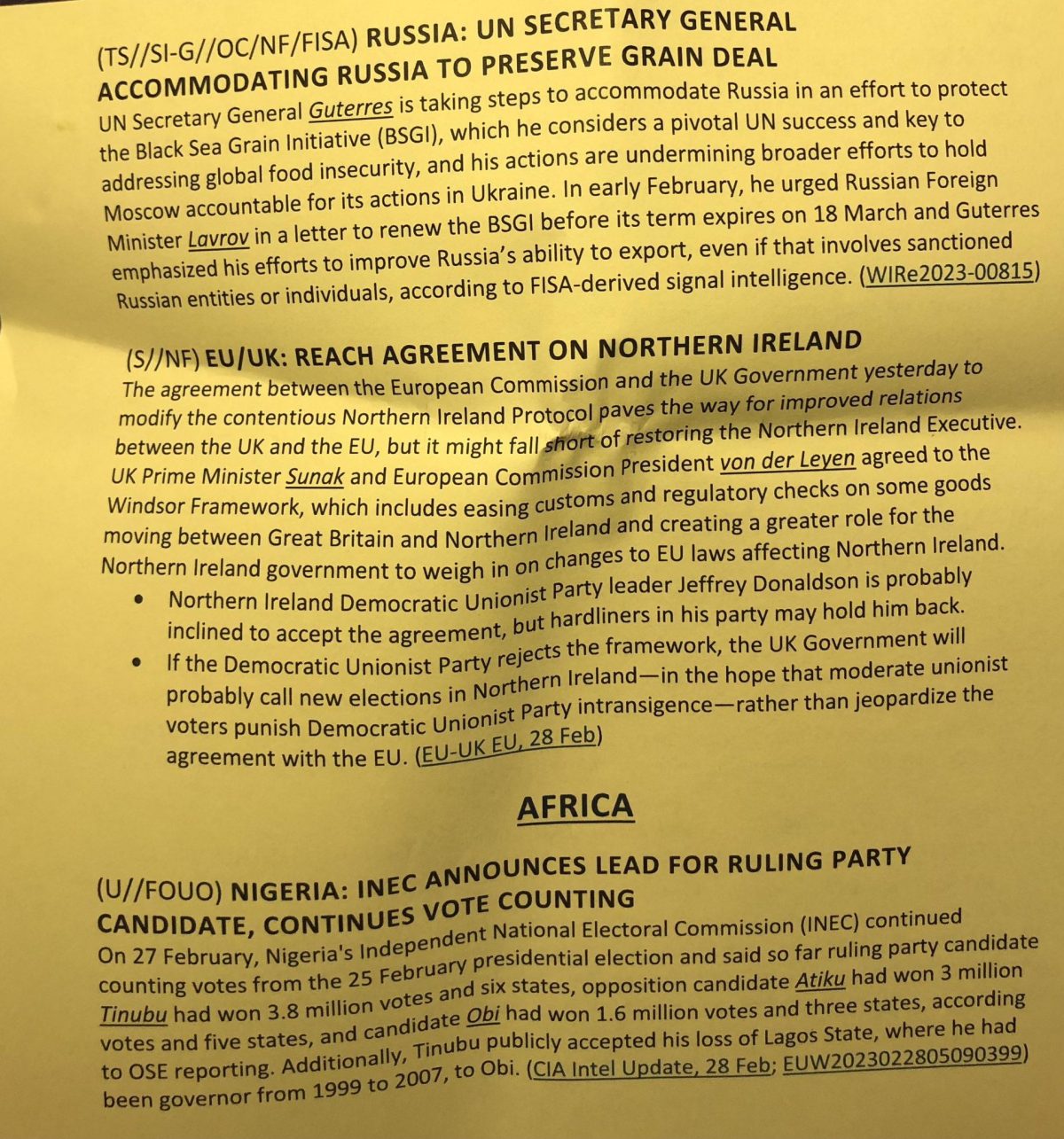
According to RT News, among the classified documents allegedly leaked by US Air National Guardsman Jack Teixeira, as part of a huge trove, is one exposing how the US is spying intently on UN Secretary-General Antonio Guterres, and is deeply unhappy that he is engaging with Moscow.
What do we learn from this leak?
Several files that Teixeira shared with other members of a private Discord chat, an action that may land him in a US supermax prison for the rest of his life, show Washington is keeping a very close eye on all Guterres’ sensitive private communications. One accuses him of “accommodating Russia to preserve [the] grain deal.” According to “FISA-derived signal intelligence,” Guterres is “taking steps to accommodate Russia in an effort to protect the Black Sea Grain Initiative (BSGI).”
“[Guterres] considers [BSGI] a pivotal UN success and key to addressing global food insecurity, and his actions are undermining broader efforts to hold Moscow accountable for its actions in Ukraine. In early February, he urged Russian Foreign Minister [Sergey] Lavrov in a letter to renew the BSGI before its term expires on 18 March and Guterres emphasized his efforts to improve Russia’s ability to export, even if that involves sanctioned Russian entities or individuals.”
The document is likely to have been written in late February or early March, before Russia and Ukraine agreed to extend the grain deal. To broker it, the UN said it would facilitate the export of Russian fertilizer and grain, which was blocked by Western sanctions despite exemptions for agricultural goods. Since the resumption, several governments have rejected grain flowing from Ukraine due to its poor quality.
Numerous other leaked documents contain accounts of Guterres’ private conversations with aides on diplomatic matters and meetings, along with accompanying commentary from US intelligence officials. Some suggest his relationship with Ukrainian President Vladimir Zelensky is far from cordial. One document referring to his trips to Iraq and Qatar in early March notes he was “not happy” about the prospect of traveling on to Kiev days after returning from Doha, despite the Ukrainian government’s request.
It’s uncertain why Guterres was resistant to visiting Kiev, but the trip went ahead, and included a private meeting with Zelensky and a joint press conference on March 8. The UN secretary-general regretted going. Another document records a conversation between Guterres and his personal spokesperson, Stephane Dujarric, in which he was “really pissed off” about an unexpected public ceremony in honor of International Women’s Day during the visit.

The document indicates aides later discussed how Zelensky had sprung the event, which included the presentation of medals to uniformed soldiers, on Guterres without warning or his consent, and later posted misleading photographs and videos that implied he was congratulating Ukrainian military personnel alongside the president. It is recorded in the file that the UN secretary-general “emphasized that he made a point of not smiling the entire time” in later conversations with aides.
No alarms and no surprises
“[Guterres] is not surprised by the fact that people are spying on him and listening in on his private conversations,” Dujarric has commented on the leaks. “What is surprising is the malfeasance or incompetence that allows for such private conversations to be distorted and become public,” the spokesman added.
Guterres’ lack of surprise that he is spied on by the US is understandable, given the country’s history of espionage targeting the UN and its senior officials. The organization’s founding charter is the product of such activity.
The US sought to manipulate the form and content of the UN by conducting espionage operations against the charter’s signatories, intercepting coded cable traffic to and from other members. This granted the US intimate advance knowledge of the negotiation positions of all 49 countries. Academic Stephen Schlesinger says the US was able to “write the UN Charter mostly according to its own blueprint” through this operation.
The US has since been repeatedly caught spying on the UN. In 2003, as the Security Council prepared to vote on the Iraq War, the NSA conducted a “dirty tricks” campaign against delegations in New York to win votes in favor of intervention. This included interception of the home and office telephones and emails delegates.
A memo from the NSA’s chief spoke of stepping up intelligence gathering operations “particularly directed at…UN Security Council Members” minus the US and UK, to gain up-to-the-minute intelligence for Bush administration officials on the voting intentions of UN members regarding the issue of Iraq.
Then, in 2010, it was revealed that Washington was running a secret intelligence operation targeting the leadership of the UN, including then-Secretary-General Ban Ki-moon, and permanent Security Council representatives from China, Russia, France and the UK. A classified directive was issued to US diplomats under Hillary Clinton’s name the previous year, demanding forensic technical details about communications systems used by UN officials, including passwords, personal encryption keys, and even detailed biometric information and credit card numbers.
By Felix Livshitz